
 By
Academic Advisor: Sandro Angulo Rincón.
A journey through the defining moments of Heberto Carrillo’s life, from his early years in Colombian professional football to the experiences that shaped his subsequent career.
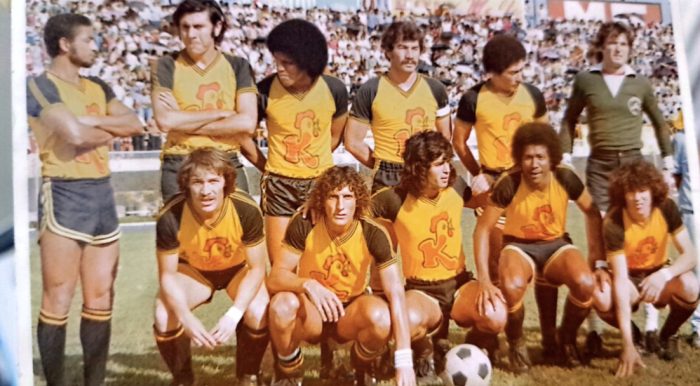
Heberto Carrillo, the first player crouching from left to right in the main photograph, was born on November 3, 1953, in Bogotá. He grew up in a family where football had been an integral part of life from an early age. One of his brothers, Gabriel, was also a professional footballer and played for Millonarios. Gabriel’s experience influenced the family’s perspective on Heberto’s sporting career, particularly after a meniscus tear disrupted Gabriel’s own career and ultimately forced him to retire.
Heberto and his siblings lost their parents when he was only twelve years old, leaving the older brothers responsible for caring for the younger ones. Gabriel consequently took Heberto under his wing, although looking after him would prove far from easy.
Heberto was never an outstanding student. He was more interested in playing football during school breaks or rushing out after classes to play in any available street or neighbourhood pitch. His childhood passion for the game eventually led him to fail fourth grade, prompting Gabriel to send him to Villavicencio, the capital of the department of Meta, to live with another older brother, Leonardo. What initially appeared to be a family difficulty would ultimately have a significant influence on his future. Years later, Heberto would recall that decision as a circumstance that helped him find his path in football.
Because Heberto developed much of his ability on small neighbourhood pitches, small-sided football played an important role in his development. The confined spaces enabled him to refine his technique, improve his movement with the ball, and develop the ability to make quick decisions during play. These qualities would remain central to his style when he eventually made the transition to eleven-a-side football.
His opportunity to pursue professional football emerged while representing the Meta departmental team, when he scored twice against Valle del Cauca in a national tournament. His performance attracted the attention of the youth divisions of Santa Fe and Millonarios, both of which invited him to join their ranks.
Heberto therefore returned to Bogotá. With Gabriel’s assistance, he moved back to the capital, this time under one clear condition: he had to fulfil his academic responsibilities. An opportunity to advance his football career soon followed. Heberto attended trials at Millonarios, alongside approximately 300 aspiring players, and was among those selected by the club.
However, his move to Millonarios still required an administrative procedure. The club needed a document certifying that Heberto was free from any contractual or registration obligations to the team he had represented in Villavicencio. To obtain it, he received assistance from the city’s mayor, who had previously served as president of the Meta Football League. Ultimately, no one travelled to collect Heberto’s transfer clearance, which eventually ended up with Santa Fe.
Although Millonarios had initially identified his potential, Heberto joined Santa Fe first. He began in the third division, but a group of Yugoslav coaches promoted him to the amateur squad and subsequently to the reserve team. That season, Santa Fe reached the league final against Millonarios. Heberto scored twice and helped secure a championship the club had not won for several years.
Six months later, Santa Fe’s Yugoslav-led development programme transferred the players’ registrations to Imprenta Nueva Granada. Heberto continued playing there and won another championship. In the final against Millonarios, held at the National University’s Gonzalo López Stadium, he converted the decisive penalty in the shootout.
Impressed by his performances as an amateur, Jaime Arroyave invited him to play for Millonarios’ reserve team in Quibdó. Heberto accepted and scored four goals in his first match. Following that performance, Arroyave informed him that he was now a Millonarios player.
During this period, Heberto had also taken the entrance examinations for the General Santander Police Academy, hoping to become a police officer. He passed the examination but was unable to complete the home-visit stage of the selection process because he was travelling with Millonarios at the time. This episode came to an end just as Arroyave succeeded in resolving the difficulties surrounding his transfer from Nueva Granada.
Eventually, Heberto secured his release from Imprenta Nueva Granada and began training with Millonarios. Nevertheless, he still had to balance football with employment and his studies while awaiting the opportunity to make the transition to the professional game.
Having nearly abandoned his ambition of becoming a professional footballer, Heberto recalls the moment he learned that he had been included in Millonarios’ first-team squad. After distinguishing himself in friendly matches involving the club’s youth teams, Dr Gabriel Ochoa told the players that he wanted to see them the following day. Carrillo, who was already working to support himself, explained that he could not attend because he would be unable to obtain leave from his job.
Ochoa took him aside and asked him to wait in his office. While waiting, Heberto gazed with excitement at the changing rooms, where the players’ shirts were displayed and the Millonarios crest appeared on numerous objects throughout the room.
When Ochoa arrived, he asked Heberto how much he earned at his job. Hoping to secure a slightly better income, Heberto exaggerated the amount. He still recalls the incident with amusement and admits that he never confessed the truth to Ochoa. The club official then told him that the Millonarios team bus would collect him the following day and take him to the training ground, officially welcoming him into the professional squad of one of Colombia’s most prominent football clubs.
Heberto remembers this episode with deep nostalgia, as it brings back the difficulties he had overcome before receiving such life-changing news. Just as he was exploring alternative possibilities for his future, his life unexpectedly took the direction he had always dreamed of pursuing.
He recalls that he originally played as a left winger for the Meta departmental team and possessed distinctly attacking qualities. When he joined Millonarios’ amateur squad, Gabriel Ochoa Uribe watched him play and explained that his natural position was neither winger nor midfielder, but left-back. Ochoa began developing him in that role, and Heberto eventually became a prominent full-back during his early professional years.
His professional debut came shortly afterwards, in a match against Once Caldas. Heberto was still competing for a place in defence when an injury to Jairo Charry during the match created an opportunity for him to enter the game. Alonso “Pocillo” López moved to the opposite flank, allowing Heberto to take over at left-back.
From that moment, he began establishing himself at Millonarios. He eventually displaced “Pocillo”, who was also a member of the Colombian national team, and gradually consolidated his position in the starting line-up.
Even after turning professional, Heberto maintained his involvement in small-sided football. Jaime Arroyave arranged permission with the Millonarios team doctor for him to represent Colombia in Porto Alegre, Brazil. The Colombian side finished third, earning Heberto a bronze medal. He also recalls that one of his goals was recognised as the best of the tournament.
Once he had established himself as a professional footballer, he permanently left small-sided football behind. Heberto acknowledges that Charry’s injury was the circumstance that opened the door to his professional career. The Millonarios doctor captured the uncertainty surrounding his debut against Once Caldas with a question that Heberto still remembers:
“A debut or a farewell?”
“Once I was with Millonarios, in the professional squad, I told myself: that’s it, my time in small-sided football is over. So, after the match I played against Once Caldas, unfortunately, that young man Charry’s injury gave me the opportunity to make my debut in professional football.”
After recovering from an injury that had even prevented him from travelling to the United States, Heberto continued to establish himself at Millonarios.
The defining moment arrived in 1978. Under the management of Pedro Rodolfo Dellacha, the team competed for the league championship. Heberto particularly remembers the decisive fixtures. In one of them, he came on during the second half against Deportivo Cali and helped secure the draw that guaranteed qualification for the Copa Libertadores. Millonarios subsequently defeated Santa Fe 3–1 at El Campín Stadium to claim their eleventh league title.
Heberto played an important role in the closing stages of that season. Against Deportivo Cali, he entered the match in the second half and contributed to the draw that secured Millonarios’ qualification. In the final match against Santa Fe, the team won 3–1 at El Campín and clinched the championship.
The Copa Libertadores also gave him the opportunity to compete outside Colombia. Millonarios recorded a historic victory over Quilmes in Argentina, becoming the first Colombian club to win a match on Argentine soil in the competition.
Although everything appeared to be progressing well for Carrillo, his career took an unexpected turn in 1980. During pre-season preparations with Millonarios, he was informed that Deportes Tolima was interested in signing him. He was told that he could travel for a trial and, if things did not work out, would have the opportunity to return to Bogotá.
Heberto accepted and travelled to join the Tolima side. However, when he returned to the capital, he received unexpected news: Millonarios no longer had a place for him. The club had decided to send him to Tolima, ruling out his return to the Bogotá squad. The decision took him by surprise, but with no alternative available, he travelled to Ibagué to begin a new chapter in his career.
Joining Deportes Tolima represented a significant change. Carrillo had come from Millonarios, a club with an established organisational structure, its own facilities, and greater resources for training. In Ibagué, he encountered a very different reality. The team did not yet have its own training ground and had to practise at the Parque Deportivo sports complex or travel to various facilities and schools throughout the city. Bus journeys became a regular part of the players’ routine.
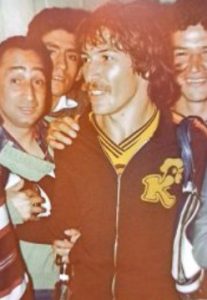
Source: Personal archive
Heberto Carrillo with Deportes Tolima supporters.
Despite these conditions, the team began to develop. New players arrived, others departed, and a squad with an increasingly distinctive identity gradually took shape. Carrillo recalls that, from 1980 onwards, the team began playing a style of football that attracted attention in cities across Colombia.
The process reached a new level with the arrival of Ricardo de León. The coach introduced a tactical system based on pressing, and the players spent several months working to understand and implement it. The initial adjustment proved difficult, but over time the squad embraced the approach, and positive results began to follow.
Carrillo eventually became a key figure in that team. His ability to contribute to attacking play and his proficiency in set-piece situations enabled him to play decisive roles in several memorable moments from that period.
The team’s development coincided with a period in which Deportes Tolima began generating an unprecedented level of enthusiasm among its supporters. Fans increasingly followed the club in large numbers, filling stadiums wherever the team travelled. In Ibagué, the relationship between the club and its supporters continued to strengthen until a tragedy abruptly interrupted that chapter of its history.
Tolima was scheduled to face Deportivo Cali at Manuel Murillo Toro Stadium. Heberto was unable to participate because he had been suspended following the previous match against América de Cali. Consequently, he was watching the game from the stands that afternoon alongside his wife and daughter.
During the match, a deafening crash suddenly interrupted proceedings. Part of the stadium’s grandstand structure collapsed as supporters approached a concrete barrier. The impact sent a cloud of dust into the air and plunged the stadium into chaos. Heberto recalls that the team subsequently stopped using Manuel Murillo Toro Stadium and had to relocate its home matches to Bogotá until the venue could be renovated and declared suitable for hosting fixtures again.
The tragedy left a lasting mark on the squad. According to Heberto, who witnessed the incident at close range, more than fifteen people lost their lives as a result of the collapse.
For Deportes Tolima, the accident meant temporarily losing its home ground. The team continued training in Ibagué but had to play its home fixtures in Bogotá. Nevertheless, these circumstances coincided with one of the most significant periods in the history of the Kokoriko generation, named after the club’s sponsor, a rotisserie chicken restaurant in Ibagué. The players had already become accustomed to competing in the capital, and it would not be long before El Campín Stadium became another setting in which they would write an important chapter of the club’s history.
One such moment occurred towards the end of the season, during a match against Junior. Tolima had established a 3–1 lead, but the Barranquilla-based side managed to draw level. In the closing minutes, Tolima was awarded a free kick approximately 35 metres from the northern goal. Víctor Hugo del Río and Cristino Centurión had already taken several free kicks during the match, but on this occasion Carrillo insisted on taking responsibility for the attempt.
Víctor Hugo del Río warned Carrillo that his teammates would not let him forget it if he failed to score. Carrillo took his run-up and struck a shot that cleared the defensive wall and nestled beside the left post of goalkeeper Delménico. The goal secured a 4–3 victory for Tolima, earning the club the league runners-up position and its best season result in the institution’s history up to that point. It also sparked celebrations that would remain firmly embedded in the collective memory. Supporters encouraged the players to take a lap of honour around El Campín Stadium, as though they had just won the championship.
“We were awarded a free kick about 35 metres from the northern goal at El Campín. Víctor Hugo (del Río) had already taken one, and so had (Cristino) Centurión. So I walked over and told them to move aside—not exactly politely, either. I felt incredibly confident. Víctor Hugo said, ‘If you don’t score this one, we’re going to knock you on the head.’ The referee blew his whistle, and I scored against (Juan Carlos) Delménico by sending the ball over the wall. […] The ball cleared the defenders and went into the left side of the goal, beyond the goalkeeper’s reach. What a magnificent goal.”
At El Campín, Tolima also found a crowd that embraced the team as its own. Following the match against Junior, Heberto’s free-kick goal prompted celebrations resembling those of a championship victory. Thousands of people remained outside the stadium, while supporters encouraged the players to complete a lap of honour. Days later, the team received a massive public welcome upon returning to Ibagué.
The result also confirmed Tolima’s qualification for the Copa Libertadores, a competition the team had begun to regard as its next major challenge. For Heberto, reaching that stage held particular significance. Years earlier, he had participated in the tournament with Millonarios, although that campaign had ended in the opening round. He was now returning to the continental competition with a team whose development had taken place under considerably more modest circumstances.
To reach that point, the players had been forced to compete away from Ibagué. The collapse of a stand at Manuel Murillo Toro Stadium had obliged the club to stage its home matches in Bogotá. The squad trained in Ibagué and travelled to the capital for competitive fixtures. Although this arrangement could have undermined the team’s performance, Heberto recalls that the players were accustomed to competing in Bogotá and were not intimidated by the conditions there.
Tolima progressed through the competition, overcoming successive opponents. For Heberto, the contrast with his earlier experience at Millonarios was unmistakable. Whereas the Bogotá-based club had failed to advance beyond the first round, Tolima’s campaign extended into the latter stages of the tournament.
“With Millonarios, we didn’t get past the first round, but with Tolima we reached the semi-finals,” Heberto recalls when comparing the two experiences.
Reaching the semi-finals made that campaign a historic milestone for Deportes Tolima. Heberto remembers it as one of the most remarkable performances by a Colombian club in the Copa Libertadores before Atlético Nacional and Once Caldas subsequently went on to win the continental title.
For him, however, the significance of that achievement extended beyond reaching the semi-finals. The experience was inseparable from the group of players Tolima had been assembling since 1980. They had arrived in Ibagué with far fewer resources than those available to other clubs, yet after several years of sustained effort, they were competing in South America’s premier club tournament.
The semi-finals represented the pinnacle of that international campaign. Although Tolima did not advance to the final, its performance had already transformed the club’s standing. The squad assembled in Ibagué had taken the institution to a stage that would remain among its greatest international achievements for many years.
For Heberto, the Copa Libertadores confirmed the progress that the team had begun making in Colombian football. The Kokoriko side was no longer merely a team capable of filling stadiums across the country; it had established itself among the continent’s leading clubs.
In Heberto’s view, Deportes Tolima in the early 1980s was very different from the institution its supporters know today. When he arrived from Millonarios, he encountered a club with extremely limited working conditions. It had no dedicated training facilities, the players shared their training ground with anyone else who wished to use it, and they had to make do with a single kit throughout the week.
The transformation began as the squad developed. Some players arrived while others departed, and Gabriel Camargo gradually recognised that the team could aspire to greater achievements. Heberto recalls that this generation spent six or seven months together in a sustained training camp environment, and that the relationships among the players proved decisive in securing positive results.
Over time, those relationships also allowed him to discover another side of Camargo’s character. Heberto acknowledges that several players struggled to adapt to life in Ibagué and wanted to leave, but Camargo encouraged them to stay and continue participating in the project. For Carrillo, this approach was one of the distinguishing features of that Tolima side and contributed to the club’s subsequent development into a much more established institution.
Following that Copa Libertadores campaign, the years passed and Heberto’s playing career entered its final stage. After representing Millonarios, Santa Fe, Bucaramanga, and Tolima, he joined Quindío, where he encountered an environment that ultimately led him to withdraw permanently from professional football.
Heberto had built his career around a strong commitment to discipline. Consequently, he found it difficult to accept that some Quindío players failed to attend training sessions or preferred going out drinking to fulfilling their professional responsibilities. At the age of 31, he decided that he no longer wished to continue. In 1987, he brought his career as a professional footballer to an end.
Retirement, however, did not keep him away from the pitch for long. That same year, he began managing a team in Colombia’s Primera C division. He had discovered that he also enjoyed coaching and could pass on to other players some of the knowledge and experience accumulated throughout his career.
Heberto’s coaching career also unfolded against the backdrop of one of the most difficult periods in Colombian football history. During the years when drug trafficking exerted considerable influence over various sectors of Colombian society, he personally confronted a situation that he still recalls with unease.
He had been appointed manager of Dinastía de Riosucio, a club competing in the Primera B division. He took charge when the team was near the bottom of the standings and succeeded in bringing it close to qualification. During that campaign, the team was preparing to face Atlético Buenaventura. The players were staying at a hotel in Riosucio when the club’s owner arrived and informed them that they were required to lose the match.
According to Heberto’s account, the decision stemmed from an order issued by Pablo Escobar. When he decided to gather his belongings and leave, he was warned that he could be killed if he stepped outside the hotel and that people were looking for him. Heberto maintains that he reported the situation to the Colombian Football Federation but received no response capable of resolving the matter.
“The club owner came in and told us we had to lose. I told him no, and asked how we could deliberately lose a match. He said it was an order from ‘Pablito’ Escobar.” […] “They told me that if I left the hotel, they would kill me, that people were looking for me.”
It remains a difficult story for him to recount. Reflecting on those years, he acknowledges that drug trafficking had permeated the environment surrounding football and that those working within the sport found it extremely difficult to remain unaffected by that reality.
After retiring from professional football, Heberto found in youth development a way to maintain his connection with the sport. For many years, he worked with players of different ages and established training initiatives, including one called Real Madrid, where he worked alongside Alfonso Cañón for nearly two decades. He also coached representative teams from Bogotá and Meta, as well as Alianza Llanos.
His understanding of player development evolved over time. Heberto does not describe himself as someone who manufactures footballers. Instead, he prefers to emphasise teaching, explaining, and competing, while allowing players to demonstrate their own abilities. For him, discipline and responsibility remain fundamental qualities for any athlete.
This philosophy has enabled him to reconnect, years later, with many players who passed through his teams. Numerous former trainees recognise him, embrace him, and express gratitude for the lessons he taught them, including those who eventually pursued professional careers outside sport. In Bogotá, Meta, and other places where he has worked, Heberto continues to encounter people who fondly remember their formative years under his guidance.
Today, he remains actively involved in football. At 72, Heberto has built not only a career in the sport but also a close-knit family comprising his wife, Edith, their four children, and six grandchildren, together with his siblings, nieces, and nephews, who have consistently supported him throughout his life. Along the way, he has forged strong personal bonds and, above all, maintained an enduring love for football.
Ultimately, football gave him far more than he could have imagined when he first began chasing a ball as a child. For this reason, whenever he discusses contemporary football and the changes the sport has undergone over the past decade, his reflections repeatedly return to the importance of player development.
Although he acknowledges that the effects of age and fatigue are increasingly evident, he continues to teach football in Restrepo, the municipality that welcomed him many years ago. He also works with Winners Meta, a club of which he is a member, seeking to instil in young players not only technical skills but also discipline and a passion for football—a sport that has defined almost every aspect of his life.
Honours and Achievements
| Year | Honours and Achievements |
|---|---|
| 1971 and 1972 | Amateur champion with Imprenta Nueva Granada in the Torneo del Olaya. |
| 1973 | Winner of the Bogotá League with Imprenta Nueva Granada. |
| 1974 and 1975 | Amateur champion with Millonarios in the Torneo del Olaya.* |
| 1974 | Winner of the Bogotá League with Millonarios. |
| 1975 | National small-sided football champion with the Bogotá Small-Sided Football League. |
| 1976 | Third place in the South American Small-Sided Football Championship, scoring the tournament’s best goal. |
| 1978 | Colombian professional league champion with Millonarios. |
| 1981 and 1982 | Colombian professional league runner-up with Deportes Tolima. |
| 1982 | Copa Libertadores semi-finalist with Deportes Tolima. |

