
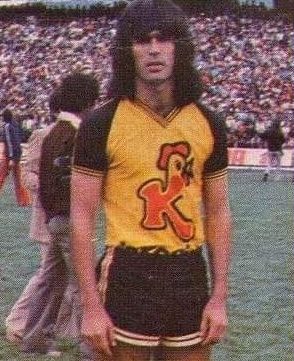
 By
By: Carlos Daniel Chaves Cárdenas, Jessica Lorena Ferreira Robayo, and Juliana Lucía Castillo Carrillo.
Academic advisor: Sandro Angulo Rincón.
Víctor Hugo del Río was born on January 1, 1953, in Resistencia, in Argentina’s Chaco Province. However, his earliest memories are associated with Quilmes, where he moved with his parents at the age of two as they sought better opportunities. Sport was already an integral part of his family. His father and his uncle Carlos were footballers, while his grandfather and his uncle Moncho were involved in boxing.
His first experiences in sport took place on informal football pitches and in the streets. He spent hours playing with his friends and his dog, or kicking a ball against a wall. He also tried to imitate his father’s movements on the pitch, where he played as a central defender. These experiences helped Víctor Hugo develop a strong, combative personality, accustomed to challenging for every ball. Nevertheless, his future would lead him to a more advanced position on the field.
An invitation to play a small-sided football match ultimately transformed his understanding of his own abilities. Having grown accustomed to playing as a defender, like his father, he arrived expecting to occupy the same position. Instead, he was asked to play as a forward, a role he had never previously performed. Despite his inexperience, he quickly discovered a new dimension to his game: he scored three goals and began to recognise his ability to control the ball and contribute to attacking play. It was the moment when he started to move beyond the defensive role in which, as he recalls, he had largely confined himself to clearing the ball.
One of the anecdotes Víctor Hugo considers particularly significant from his early footballing years involves his mother. On one occasion, she saw him crying because he could not execute a particular move as he intended. Víctor Hugo attempted to demonstrate the movement with his hands. Rather than encouraging him to abandon the idea, his mother urged him to believe in himself. She reminded him that he was intelligent and capable of achieving his goal. Víctor Hugo treasured that advice, which accompanied him throughout his development and strengthened his dribbling skills, an ability that would eventually become one of his defining characteristics as a footballer.
Over time, his talent began to attract attention at Quilmes Atlético Club. He spent approximately four years there before receiving an opportunity that would fundamentally change his career. From an early age, sacrifice was an essential part of his development. Attending training sessions required long train journeys, sometimes without enough money even to buy food along the way. Exhausted by these circumstances, he came close to abandoning his footballing ambitions. Yet football had another path in store for him.
A full-pitch match against Racing Club de Avellaneda became his gateway to one of the most important institutions of his career. José Santiago, who had known him since his early years at Quilmes and was now associated with Racing, approached him after the match, requested his identification documents, and informed him that he would begin playing in the ninth division of La Academia, the nickname by which the Avellaneda club is known. Víctor Hugo had barely had time to absorb the news when, just one week later, he was already wearing Racing’s distinctive sky-blue-and-white shirt.
His time in Avellaneda lasted seven years, although his development was considerably faster than usual. Within just five years, he progressed through every youth category, generally playing alongside footballers two or three years older than himself. His experience on informal neighbourhood pitches had given him an advantage: he was accustomed to competing against older players and was never intimidated by physical challenges.
At Racing, he established a reputation of his own. His technical abilities led the club to recognise him as one of the outstanding players of his generation, earning him the nickname El Marqués (“The Marquis”), in reference to Rubén Héctor Sosa, one of La Academia’s legendary figures. He won championships in the fourth and third divisions and reached the professional youth category at just 18 years of age. He also shared training and playing environments with footballers who had already achieved considerable success in Argentine football and who would later become world champions or prominent figures in major international competitions.
However, his route into professional football did not materialise at La Academia. José Pizzuti, the coach who had won the world club title with Racing, acknowledged his abilities but decided not to include him in the first team. Víctor Hugo was therefore forced to seek opportunities elsewhere. He spent time at Arsenal de Sarandí before returning to Racing. Subsequently, an internal restructuring at the club led him to Lanús, then competing in Primera B, where he remained for two years and achieved promotion.
It was also at Lanús that one of his childhood idols unexpectedly entered his professional life. Ángel Clemente Rojas, a player he had admired since childhood, became his teammate and even, on occasion, his substitute. For Víctor Hugo, sharing a dressing room with someone he had once idolised seemed like an almost impossible coincidence. The footballer he had previously admired from afar ultimately became both a colleague and a friend.
His career in Argentina, however, was about to take a different direction. An injury prevented him from travelling with Lanús to a pre-season training camp in Bolivia and Peru. Nevertheless, a few days later, he played in a friendly match against Talleres de Remedios de Escalada. Among the spectators were two officials from Cristal Caldas, a club based in the Colombian city of Manizales. What Víctor Hugo regarded as simply another match ultimately opened the door to a country he had previously known only by name.
This was not the first time Víctor Hugo had considered the possibility of playing abroad. Clubs from Uruguay, France, and Germany had previously expressed interest in him, but none of those approaches had developed into a formal offer. This time, however, the situation was different. Despite several delays in the negotiations, an agreement was eventually reached.
Unlike his father, who regarded the Colombian offer with scepticism, Víctor Hugo was willing to accept it. Doing so meant leaving the country where he had grown up, developed as a footballer, and established his first professional relationships. Furthermore, his wife was pregnant, giving the journey an even greater significance for the family. Nevertheless, he decided to embrace the challenge.
As part of the transfer, he received an advance payment of US$10,000 and travelled to Colombia with his wife. He did not know exactly what awaited him in the northern part of South America, but he understood that he was leaving behind an important chapter of his life to begin another. He was arriving in a country he knew only through limited accounts and entering a footballing environment that, as he would soon discover, approached the game very differently.
The first thing Víctor Hugo was asked to do upon arriving in Colombia was to cut his hair. He had worn it long for years, and his hairstyle had become an important part of his identity, accompanying him throughout much of his development and professional career.
When he was approximately five years old, he went out for a walk with his father. However, as they approached a barbershop, his father began to cry. It was the only occasion on which Víctor Hugo ever saw him do so. When he asked what was wrong, he discovered that his father had brought him there to have his hair cut.
Víctor Hugo resisted, kicking his legs and refusing to sit in the barber’s chair. Eventually, his father had to hold him still while the barber began cutting his hair. The reason was that he would be starting school within a few days, and the institution did not allow boys to wear their hair long. His father promised that, once he had completed primary school, he would be free to wear his hair however he wished.
From that moment onwards, long hair acquired a special meaning for Víctor Hugo. One particular remark from his father remained etched in his memory: he told him that his good fortune lay in his long hair. Víctor Hugo embraced that belief and maintained his hairstyle throughout his career in Argentina, even when clubs imposed fines on him for doing so.
The demand that he cut his hair upon arriving in Colombia therefore represented considerably more than a simple change in appearance. As he embarked on a new stage of his life and career, he was being asked to relinquish one of the characteristics most closely associated with his identity.
Adapting to life in Colombia was not easy for Víctor Hugo or his wife. During their first few days, they stayed in a hotel and had to become accustomed to a different culture and unfamiliar customs. Even something as ordinary as breakfast represented a significant adjustment. Víctor Hugo was accustomed to drinking mate, the traditional Argentine infusion, whereas in Colombia he encountered a wide variety of egg-based dishes.
A woman working at the hotel noticed the difficulties they were experiencing and decided to help. She offered to prepare a different breakfast for them each day, providing valuable support during those initial days.
Food was another aspect of the adaptation process. Víctor Hugo tried to explain how he wanted his meat prepared, hoping to be served milanesas, the breaded meat cutlets popular in Argentina. However, differences in culinary traditions meant that the initial attempts were quite unlike what he expected: instead, he was served steak with eggs. These dietary changes eventually affected his physical condition. Rather than gaining weight, he began to lose it, while his wife, who was pregnant, also lost weight during their first days in the country.
Alongside these challenges came the difficulty of adapting to Colombian football. Víctor Hugo was cabulero, a term used in Argentina to describe someone who believes in superstitions and rituals associated with good or bad luck. During his first matches, goals seemed to elude him. His shots struck the goalposts, went wide, or were cleared off the line by opposing defenders. During a storm in Manizales, an advertisement for a chicken retailer was blown away by the wind, prompting jokes from those who associated the incident with Víctor Hugo’s apparent misfortune in front of goal.
Eventually, however, the goals began to come. Víctor Hugo never considered himself an out-and-out goalscorer. In Argentina, he had typically scored between 14 and 15 goals per season, although he had also earned the nickname “the king of penalties” because of the number of fouls committed against him inside the penalty area. For him, intelligent, technically accomplished football mattered more than statistical achievements.
After a difficult first season, Víctor Hugo began preparing more effectively. In his second year, he scored seven goals; the following season, he reached 21. He maintained his impressive attacking form in the subsequent campaign, scoring another 19 goals. His performances increasingly attracted attention, and Víctor Hugo began establishing himself as one of the leading players in Colombian football.
At that point, the possibility of a transfer to América de Cali emerged. Negotiations between the clubs appeared to be progressing favourably, and Víctor Hugo expected to become one of the Cali-based club’s new signings. However, one afternoon, while listening to the radio, he heard his name associated with an entirely different destination.
Víctor Hugo had expected to hear América de Cali mentioned, but towards the end of the programme, it was announced that he had been transferred to Deportes Tolima. The news took him completely by surprise. It was not the destination he had anticipated, and his initial reaction was one of immediate disappointment.
He subsequently received a telephone call from Gabriel Camargo, president of Deportes Tolima, who sought to persuade him to join the club’s ambitious project. Camargo promised that he would become one of the highest-paid players in the squad and that a competitive team would be assembled around him. Although the financial terms were significant, Víctor Hugo was also attracted by the opportunity to become a leading figure in an emerging sporting project.
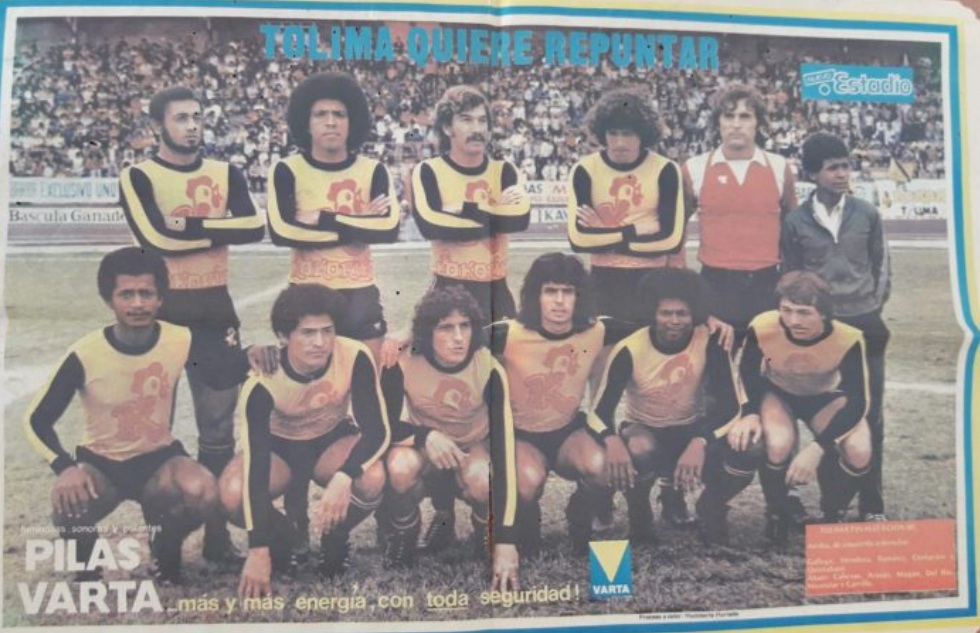
Source: Personal archive
Deportes Tolima in 1980. Back row, from left to right: Gallego, Mendoza, Ramírez, Centurión, and Quintabani. Front row, from left to right: Cabezas, Araújo, Mungía, Del Río, Montúfar, and Carrillo.
Ultimately, Víctor Hugo accepted the offer. Several players from Caldas joined him, along with other footballers who completed the new squad. Altogether, approximately seven players were brought into the team, laying the foundations for a project that would mark a new chapter in Víctor Hugo del Río’s career.
His arrival in Ibagué marked the beginning of a new stage in his professional development. At the time, the club did not have its own training ground, meaning that training sessions had to be held at various sporting facilities and schools across the city, requiring the players to travel frequently between locations.
Each day began with a journey to the Parque Deportivo sports complex, although travelling to other pitches throughout the city was also common. Despite the less-than-ideal conditions, Víctor Hugo recalls that period with affection. The constant journeys became part of the experience and helped forge a collective identity among a newly assembled group of players beginning to establish itself in Ibagué.
The team was seeking to develop a distinctive identity. Víctor Hugo recalls that, over time, new players arrived, others departed, and the squad gradually evolved. Then, in 1981, a figure emerged who would transform the way football was understood throughout the city.
Ricardo de León arrived with a tactical approach that was innovative for its time. His philosophy centred on applying constant pressure to opponents, a system Víctor Hugo remembers as pressing. The objective was to regain possession quickly and ensure that the team remained organised to press opponents across every area of the pitch.
The transition was not immediate. For three months, the squad underwent intensive training sessions in the morning, afternoon, and evening. Initially, results were disappointing: the team went through matches without securing victories as the players struggled to assimilate the new system. Gradually, however, they began to understand its principles, and positive results followed.
Once the team had fully mastered Ricardo de León’s tactical philosophy, an entirely different period began. Collective performance improved, and victories became increasingly frequent. That squad eventually became remembered by many of its members as the legendary “Kokorico Tolima”, a period that also represented a major breakthrough in Víctor Hugo’s career.
That year also brought individual recognition that would leave a lasting mark on his career. Víctor Hugo finished as the season’s leading goalscorer and was named its outstanding player. The achievement carried particular significance because he had prevailed in competition for a place in the team against a footballer of considerable experience who was also his friend: the Peruvian César Cueto, then playing for Atlético Nacional.
Following the recognition achieved in the previous season, the group continued to develop. The players had assimilated Ricardo de León’s system, and its tactical principles were becoming a defining characteristic of the team. Months of preparation began to translate into performances on the pitch, and Deportes Tolima developed a distinctive playing identity that enabled the club to challenge for the leading positions in the league that year.
Víctor Hugo established himself as an important member of the squad. His competitive temperament meant that, during matches, he remained attentive to his teammates’ performances and to mistakes that could be corrected. High standards were central to his understanding of football. For him, every match had to be approached with the intention of winning.
Relationships among the players also grew stronger away from the pitch. As the matches accumulated, jokes and anecdotes emerged that would eventually become part of the team’s collective memory. Víctor Hugo recalls a particularly close-knit group in which victories provided opportunities to celebrate and spend time together. Once a match began, however, the atmosphere changed completely.
During that season, one of the most painful incidents Víctor Hugo remembers from his time in Ibagué occurred. On November 18, 1981, during a match against Deportivo Cali at the Manuel Murillo Toro Stadium, part of the stadium’s stands collapsed, causing an accident that left several people injured. Víctor Hugo was inside the stadium when he heard the noise and went onto the pitch with his teammates to find out what had happened.
His immediate concern was to locate his wife and children, who were among the spectators. As he emerged, he saw ambulances and people attempting to assist the injured. Among them was a child being carried on a stretcher:
“I could see that the child had a serious head injury. The scene left me paralysed for a few seconds, until I finally found my family and confirmed that they were safe,” he recalls.
He had already sensed that certain aspects of stadium operations were not being managed appropriately. Frequently, when arriving at the Manuel Murillo Toro Stadium, he noticed children and young people managing to enter without tickets. This recurring situation revealed inadequate controls over spectator admission and the number of people permitted to occupy the stands. In retrospect, those shortcomings led Víctor Hugo to believe that the tragedy might have been prevented.
The accident also had consequences for the team. The stadium was taken out of service, forcing Deportes Tolima to relocate its home matches to Bogotá. This meant playing away from Ibagué, although the squad already had experience training and competing in the Colombian capital. Nevertheless, the players missed their city. The team had developed a special relationship with its supporters and now had to play its home fixtures hundreds of kilometres away.
Bogotá ultimately became the setting for some of the most significant moments in the club’s history up to that point. The first came against Junior, in the match that would determine the runners-up position in the 1981 league championship and qualification for the following year’s Copa Libertadores.
The match produced one of those moments that become part of the enduring history of a dressing room and an entire city. Víctor Hugo and Cristino Centurión were preparing to take a free kick when Heberto Carrillo confidently declared that he would be the one to score. Víctor Hugo was not particularly convinced of Carrillo’s ability from set pieces but decided to let him take the attempt.
Carrillo began his run-up and struck the ball. Víctor Hugo, who had watched him intently as he prepared to shoot, noticed the left-footed defender’s reaction before following the ball’s trajectory. The shot flew into the top corner, and the goal ultimately secured the runners-up position for Deportes Tolima. The players gathered around Heberto in celebration, cementing his place among the most memorable figures of that squad.
Víctor Hugo also remembers a particular habit of Carrillo’s. Whenever he delivered a good cross, he expected recognition from his teammates. When the ball failed to reach its intended target, however, he preferred to look away and pretend that the move had nothing to do with him. Over time, such episodes became part of the friendship they developed within the team.
That successful campaign also opened the door to a competition that represented an entirely new experience for Víctor Hugo: the 1982 Copa Libertadores, where he would face some of the most prominent clubs in South American football.
For Víctor Hugo, qualifying for the Copa Libertadores meant taking the Ibagué-based squad into a completely different competitive environment. The team had learned how to compete successfully in Colombia; now it would have to demonstrate its abilities beyond the country’s borders.
One of his earliest significant memories of the tournament came against Cobreloa. Deportes Tolima secured victory at El Campín Stadium before a crowd that Víctor Hugo recalls as numbering approximately 60,000 spectators. He scored one of the goals himself and subsequently became the central figure in an unusual incident during the journey to Chile for the return fixture.
At the airport, while his teammates proceeded through an area designated for the squad, Víctor Hugo was directed elsewhere. An official approached him and asked him to follow. He began to worry about what might be happening, even suspecting that someone could have placed an illegal substance or object in his luggage.
He was escorted to an area surrounded by police officers and security personnel. There, he encountered television cameras, journalists, spotlights, and microphones. Only then did he realise that the situation had nothing to do with his luggage; rather, it reflected the considerable media interest generated by his performance in the previous match. He answered the journalists’ questions, and when the interview ended, one of the officials even reminded him not to forget his bag.
The team’s Copa Libertadores travels continued throughout that semester. After spending several days in Chile, they returned to Colombia. They subsequently prepared to travel to Argentina and then to Paraguay to face Olimpia. During one of these journeys, another anecdote emerged that Víctor Hugo still recalls from that Libertadores campaign.
During a training session at the Ferro Carril Oeste ground in Buenos Aires, while the players were warming up, several children attending a holiday camp approached to watch them. Upon seeing the footballers, the children began pointing towards the Black players in the squad and associating them with Cameroon’s national team. Their innocent reaction prompted laughter among the players and became one of the many memorable stories from the club’s first international campaign.
Participation in the Copa Libertadores took Deportes Tolima into a competitive arena that had seemed beyond its reach only a few years earlier. The club had established itself among the leading teams in Colombian football, and that generation of players began to occupy an increasingly significant place in its history.
Over time, Víctor Hugo del Río’s performances, goals, and sustained presence in Ibagué made him an increasingly recognisable figure among the club’s supporters.
His importance within the squad continued to grow. He was one of its longest-serving players and understood the transformation the club had undergone since its earlier years, when it had been far from a major force in Colombian football. He had experienced the entire process and contributed directly to the team’s consolidation.
This shared journey gave his relationship with Deportes Tolima a distinctive character. Víctor Hugo had not joined an already established team merely to experience another stage of his professional career. Instead, he had developed alongside an institution that was simultaneously building its own history.
As the years passed, his statistical achievements added another dimension to that relationship. His goals accumulated, and his name increasingly appeared among the club’s most celebrated figures. For supporters, Víctor Hugo became synonymous with what they regarded as the finest period in the institution’s history.
Yet his significance extended beyond his achievements on the pitch. In Ibagué, he had raised his family, established friendships, and spent a substantial part of his life. The city that had initially represented an unfamiliar destination had gradually become his home.
Thus, almost without realising it, the footballer who had arrived from Argentina became one of the most important figures in the history of Deportes Tolima. Nevertheless, his professional career still had another chapter to unfold away from the club.
That opportunity came with Atlético Nacional. For Víctor Hugo, moving to Medellín represented a new challenge at a stage when he had already established a distinguished career in Colombian football. Nacional was a club with considerable ambitions, and the transfer also offered the possibility of competing in a different environment.
However, his time at the club did not develop as he had anticipated. The sporting project began moving in another direction, and the arrival of Francisco Maturana marked a significant turning point. The coach had a clear vision: he wanted to build a team composed primarily of Colombian players.
Consequently, Víctor Hugo began to be sent on loan to other clubs. This situation marked a different stage in his career. After spending years as a leading figure at Deportes Tolima, he once again had to seek opportunities elsewhere and adapt to unfamiliar squads.
Atlético Nacional’s decision brought him closer to the end of his playing career. After so many years competing for a place in the starting line-up, he began to question how much longer he wished to continue under those circumstances. He had arrived in Colombia as a young man and, by then, had spent approximately a decade building his life in the country:
“My time at Nacional was one of the final stages of my playing career. Other destinations would follow, along with a transition that gradually led me to consider football from a different perspective.”
Eventually, he felt that the constant struggle for a place in the team no longer held the same meaning for him. Following a brief spell at Deportivo Pereira, and after approximately a decade in Colombia, he realised that the time had come to close that chapter. He returned to Argentina and, although his playing career initially appeared to be approaching its conclusion, one final opportunity awaited him.
Villa Dálmine expressed an interest in signing him, and Víctor Hugo, now an experienced 34-year-old, agreed to attend a trial. He arrived after several days of illness, but this did not prevent him from demonstrating his abilities. During a training match, the reserve side faced the first team and secured a remarkable 6–1 victory. Víctor Hugo scored four of the goals.
His performance was sufficient to convince the club’s management. The president asked him how much he expected to earn, and Víctor Hugo proposed an amount he considered fair for returning to professional football in the Primera B Metropolitana, the third tier of Argentine professional football. An agreement was reached, and he received part of the payment in advance.
That return allowed him to extend his playing career for several more years, but it also confirmed that retirement was approaching. He had begun to experience the physical strain of so many years of competition and travel. Having played professionally in both Argentina and Colombia, he understood that his body and personal priorities were beginning to demand a different way of life.
Ultimately, he decided to retire from professional football. There was no single defining moment that prompted his departure from the game. Rather, it was a decision that developed gradually as he came to recognise that he no longer wished to continue fighting for a place in the team, as he had done throughout his career.
However, retiring from professional football did not mean distancing himself from the sport. Víctor Hugo found in coaching and player development a new way to remain connected to the game that had accompanied him throughout his life. He began undertaking specialised training and attending coaching courses, drawing on the knowledge and experience accumulated during his years as a professional footballer.
This new chapter initially led him to work with youth teams and subsequently to serve as an assistant coach to Hernán Torres. At the same time, he began developing another area of expertise that would become fundamental to his life after retirement: identifying and nurturing footballing talent.
Although his playing career had come to an end, his relationship with football was simply evolving. Over the following years, he travelled throughout Colombia in search of promising young players, eventually recommending approximately 119 footballers, including Julio Hernández, Trujillo, Campaz, and Chará.
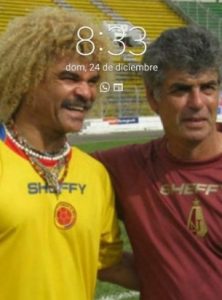
Source: Personal archive
Víctor Hugo del Río in his role as technical advisor and talent scout for Deportes Tolima, pictured alongside Carlos “El Pibe” Valderrama.
Over the years, Víctor Hugo del Río secured a distinguished place in the history of Deportes Tolima. His 63 league goals continue to rank him among the club’s all-time leading goalscorers, while his name remains permanently associated with one of the most significant generations of players in the institution’s history.
His story is inseparable from Kokoriko Tolima, the sporting project that transformed the club’s standing within Colombian football. Víctor Hugo was one of the leading figures of that team, sharing the pitch with players whose achievements remain deeply embedded in the memories of its supporters. The generation of the early 1980s propelled Deportes Tolima into contention for the leading positions in the domestic championship and secured its participation in the Copa Libertadores, marking one of the most consequential periods in the club’s history.
Today, many years after retiring from professional football, Víctor Hugo continues to live in Ibagué. The city eventually became his home, and Deportes Tolima still occupies a special place in his life. He hopes to re-establish closer ties with the club, become actively involved once again, and contribute in whatever capacity his experience and knowledge may allow.
Víctor Hugo del Río arrived in Colombia seeking an opportunity to continue his professional career. What he found was far more meaningful. He discovered a city and a football club with which he would build a fundamental part of his life. Today, from Ibagué, he continues to follow Deportes Tolima with the same affection and commitment that once inspired him to step onto the pitch and defend its colours.
Career Honours and Achievements
| Year | Honours and Achievements |
|---|---|
| 1976 | Promotion to the First Division |
| 1981 | Top scorer of the Colombian Championship with Deportes Tolima, scoring 29 goals |
| 1981 | Set the all-time record for goals scored in a calendar year for Deportes Tolima |
| 1981 and 1982 | Runners-up in the Colombian Professional Football League with Deportes Tolima |
| 1982 | Became Deportes Tolima’s all-time leading goalscorer in the Copa Libertadores |
| 1982 | Reached the Copa Libertadores semi-finals with Deportes Tolima |
| — | Third-highest goalscorer in Deportes Tolima’s history |

