

 By
By Another ethical challenge in journalism is reporting on sports practiced by athletes with disabilities without resorting to stigma or stereotypes.
By Sandro Angulo Rincón
1960 was a groundbreaking year for global sports. For the first time, the inaugural Paralympic Games were held in Rome, featuring mostly young male soldiers in wheelchairs with spinal cord injuries. A total of 400 athletes from 23 countries competed, aiming to demonstrate to the world that, regardless of physical, mental, or sensory conditions, inclusion in social life is possible, and high athletic performances can be achieved.
Today, disability can encompass congenital or acquired physical or intellectual impairments that meet the eligibility criteria set by the International Paralympic Committee’s classification code. These impairments include reduced muscle strength, limited passive range of motion, limb deficiency, leg length discrepancy, ataxia (a neuromuscular disorder affecting coordination and movement), hypertonia (a neuromotor disability associated with cerebral palsy, traumatic brain injuries, strokes, or certain neurological diseases), athetosis (a neuromotor disorder characterized by involuntary, slow, and writhing movements), short stature, as well as visual and intellectual disabilities.
From 1960 to the recent Paris 2025 Paralympic Games, adaptive sports have faced numerous challenges. Perhaps the most significant among them is achieving the same level of sporting, media, and cultural recognition that society grants to the Olympic Games.
David McGillivray and his colleagues, authors of the study Repurposing the (Super)Crip: Media Representations of Disability at the Rio 2016 Paralympic Games, argue that the media has played a crucial role in gradually shifting adaptive sports away from their strictly therapeutic value toward elite, prestigious competitions. Moreover, the continuous coverage of adaptive sports has driven the development of public policies to promote them, sparked the interest of sponsoring brands, and captured the attention of academics who now analyze them in classrooms from the perspectives of social and human sciences, rather than solely from medical viewpoints.
However, the media continues to provide asymmetrical coverage of Paralympic sports, dedicating significantly less airtime and space to the performances of para-athletes compared to athletes without disabilities. This issue becomes even more complex when critically examining the role of the press and its reporters in perpetuating stigmas and stereotypes in the representation of athletes with disabilities or functional diversity.
One of these stereotypes is the ableist media narrative, aligned with the medical model, which emphasizes disability rather than athletic performance. Emma Pullen and other researchers, in Re-presenting the Paralympics: (contested) philosophies, production practices and the hypervisibility of disability, point out that one reason why the ableist discourse persists in relation to para-sports as a cultural form is that journalists are accustomed to emphasizing “perfect, idealized (gendered) neoliberal bodies,” making disability a challenging topic to address. Consequently, for many people, the para-athlete is still perceived as a “patient battling their limitations” rather than an elite athlete with specific talents or virtuosity.
Another stereotype, commonly known in the Anglophone world as the “supercrip”, revolves around the typically “inspirational” stories of Paralympic athletes who defy the odds to achieve remarkable athletic feats. This narrative frequently highlights triumph over adversity, creating the impression that what seems impossible is, in fact, attainable. Carla Silva and David Howe, in their study The (In)validity of Supercrip Representation of Paralympian Athletes, suggest that this portrayal undermines the position of people with disabilities. On one hand, it elevates them to a heroic status by labeling them as “super” athletes, setting them apart even from others within the disability community. On the other hand, it emphasizes the idea that disability can be “overcome” through sheer hard work and determination, downplaying the structural and attitudinal challenges that most people with disabilities face. Critics of the “supercrip” narrative argue that it distracts from the real, material barriers encountered by people with disabilities—such as non-inclusive infrastructure and lack of financial support—by offering the public the illusion that “super” para-athletes can build successful careers and transcend their disabilities through personal effort alone.
Both narratives have the potential to be harmful—either by perpetuating negative perceptions of disability through the medical model or by creating a divide between those who can participate in elite sports and those who cannot (“supercrip”).
The media has also been criticized for adopting a hierarchy of disability, categorizing certain impairments as more “normal” or “acceptable” to the public. For instance, athletes in wheelchairs tend to receive the most visibility, followed by amputees, while disabilities that may be visually striking—such as cerebral palsy—are often absent from coverage altogether.
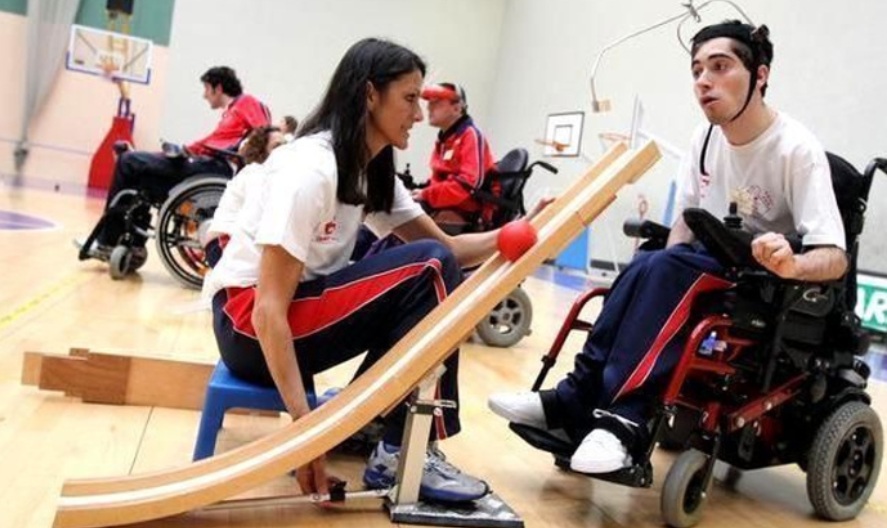
Source: Mayor’s Office of Pasto
Another trend highlighted by researchers Leanne Rees, Priscilla Robinson, and Nora Shields in Media Portrayal of Elite Athletes with Disability – A Systematic Review is the spectacularization of the Paralympic Games. This phenomenon has led to a preference for hybrid athletes and their cybernetic prosthetics, which captivate an audience obsessed with technology and driven by the expectation of extraordinary athletic feats. Additionally, research indicates that female para-athletes receive significantly less media coverage than their male counterparts.
In Spanish, the term “discapacidad” (disability) can, in some sports contexts, be replaced by “diversidad funcional” (functional diversity). While the former implies an inability to perform certain actions, the latter highlights that differences in physical, mental, or sensory abilities are a natural part of the human experience. This perspective shifts the focus away from individual limitations as “deficiencies” or “problems”, promoting a more inclusive and respectful narrative. For all broadcasting commentary, impairment should be used instead of disability
In the long run, the ultimate goal is to eliminate the need for either term, so that these individuals are simply referred to as athletes. This shift would allow their sporting achievements to take center stage, fostering a more inclusive perspective and driving positive societal change.
The International Paralympic Committee Style Guide outlines several general rules for speaking, interviewing, or interacting with a person with a disability:
- Always identify the person first and then the impairment, e.g. “an athlete with an impairment” not a “disabled athlete”. Sometimes it may not be necessary or relevant to mention the impairment, so don’t feel obliged to do so. When it is relevant, just mention what the impairment is and then move on.
- Act naturally and don’t monitor every word and action. Don’t be embarrassed if you use common expressions like “see you later” (to a person with a visual impairment) or “I’d better run along” (to someone who uses a wheelchair).
- Avoid using emotional wording like “tragic”, “afflicted”, “victim”, or “confined to a wheelchair”. Emphasise the ability and not the limitation, by saying that someone “uses a wheelchair” rather than “is confined” or “is wheelchair-bound”.
- Avoid portraying people with an impairment who succeed as “extraordinary” or “superhuman”. For example, overstating the achievements of athletes with an impairment inadvertently suggests the original expectations were not high.
- Portray the person as he/she is in real life. For example, a person with an impairment might be an athlete but he/she may also be a parent, a civil engineer, a doctor, a business manager or a journalist.
- People do not want to be recipients of charity or pity. Remember that a person with an impairment isn’t necessarily chronically sick or unhealthy.
- Always ask a person with an impairment if he/she would like assistance before rushing in. Your help may not be needed. However, it is quite all right to offer help. If your assistance is needed then listen or ask for instructions.
- When talking with a person who has an impairment, speak directly to that person rather than a companion or interpreter.
- Don’t forget that people with an impairment may need your patience and sufficient time to act independently. Give the person extra time to speak if they are using a communication aid or have a learning impairment.
- Ask persons with an impairment to repeat themselves if you do not understand them.
- Respect the person’s personal space and remember that a wheelchair is part of a person’s personal space.
- When greeting a person, if you normally shake hands, then offer the same gesture, even if the person has limited use of his/her hands or wears prosthesis. The person will let you know if a certain action is appropriate or not.
- Do not assume that a person with a physical impairment also has a hearing impairment or that his/her mental capacity is diminished in any way. Speak in a normal tone and do not use language that is condescending.
Appropriate words and phrases
According to the International Paralympic Committee Style Guide, words have the power to shape perceptions and can either reinforce inaccurate images or cause harm. Below is a list of preferred terminology and appropriate language when referring to athletes with disabilities in general.
| Avoid | Use |
| Disabled athlete/person Handicapped athlete/person Athlete/person with disabilities Athlete(s) with disabilities or disabled athlete(s) | Athlete or (where a distinction needs to be made) the preferred term is Para athlete or athlete(s) with an impairment Person(s)/People with an impairment |
| Athlete/Person with a vision impairment, The blind | Athlete/Persons with a visual impairment / blindness and (visually impaired is also acceptable, especially to improve the flow of sentences). An athlete who has been classified as having a visual impairment |
| The handicapped The disabled The physically handicapped Person with a locomotor disability | Persons with a physical impairment A person who has been classified as having a physical impairment, e.g. amputees, wheelchair users, people with cerebral palsy etc |
| Normal athletes Calling able-bodied people ‘normal’ is derogatory to people with an impairment who are equal to their able-bodied counterparts. | Able-bodied athletes or where possible Olympic athletes |
| A paraplegic, paraplegics | A person with paraplegia |
| A quadriplegic, quadriplegics | A person with quadriplegia |
| A retard / the retarded | A person with an intellectual impairment |
| Spastic | A person with cerebral palsy |
| Abnormal, subnormal, defective, deformed These are negative terms which imply failure to reach personal perfection | Specify the impairment |
| Afflicted with Most people with an impairment do not see themselves as afflicted | Say the person has… (the impairment) |
| Confined to a wheelchair A wheelchair provides mobility and is not confining | Say uses a wheelchair |
| Cripple or crippled Invalid These words convey a negative image of a twisted ugly body. | Say with a physical impairment |
| Disease (when used as equal to impairment) Many disabilities, such as cerebral palsy and spinal injuries, are not caused by any illness or disease | Say impairment |
| Stumps This has the connotations that the person’s limbs were cut off like a tree | Say amputation |
| Suffers from, sufferer People with an impairment do not necessarily suffer | Say is/has… (an impairment) |
| Victim People with an impairment are not necessarily victims and usually prefer not to be perceived as such |
Say is/has… (an impairment) |
Additionally, it is important to remember that disability is merely a characteristic or a life circumstance—it does not define a person’s entire existence. Life itself is often stronger and more significant than any form of disability.
Professor José Luis Rojas Torrijos publishes a Brief Style Guide for Properly Reporting on the Paralympic Games on his blog, Periodismo Deportivo de Calidad. Here are some of his key recommendations:
The media and journalists should normalize the coverage and publication of news pieces about athletes with disabilities, just as they routinely do for athletes without disabilities.
Avoid expressions such as “people with mobility problems” (instead, use “people with reduced mobility”) or “people with vision problems” (preferably, “people with visual impairment” or “blind people”).
A fundamental principle in journalism is that the language used for reporting should be easily understood by the majority of readers. The same applies when covering disability or adaptive sports. If it is necessary to mention acronyms or technical and scientific terms, it is the journalist’s responsibility to clearly and simply explain their meaning.
Journalists and media outlets have the responsibility to stay informed and continuously update their knowledge about different types of disabilities, their characteristics, and specificities, as well as the various adaptive sports disciplines, to ensure professional and accurate coverage of events featuring these athletes.
Finally, journalists should learn and communicate the rules and competition formats of the 22 Paralympic sports: athletics, badminton, wheelchair basketball, boccia, cycling, equestrian, wheelchair fencing, football 5-a-side, goalball, powerlifting, judo, swimming, canoeing, rowing, wheelchair rugby, wheelchair tennis, table tennis, shooting, archery, taekwondo, triathlon, and sitting volleyball.
The Watchdog Role of the Media
While the media must work to increase the visibility of adaptive sports without perpetuating stigmas or stereotypes, this does not exempt them from their watchdog duty when athletes, coaches, or officials violate the rules to gain an unfair advantage over their competitors. An example of responsible journalism and investigative reporting is the work of Matt Higgins and Roman Stubbs from The Washington Post. In their August 28, 2024, report, As Paralympics Get Bigger, Some Athletes Say Cheating Is More Prevalent, they expose widespread suspicions that some athletes exaggerate their level of disability to gain an easy victory over their opponents. This practice, known as “classification doping,” involves manipulating classification assessments to be placed in a category where an athlete’s physical, sensory, or cognitive impairment is less severe than that of their competitors. This occurs under the passive oversight of Paralympic authorities, who often refrain from imposing sanctions or exposing dishonest cases to preserve the image of transparency and perseverance associated with para-athletes.
It is worth recalling the most infamous Paralympic cheating scandal, which occurred during the Sydney 2000 Games. Spain’s men’s intellectual disability basketball team won the gold medal, despite fielding a roster in which 10 of the players had no cognitive impairment whatsoever.
The scandal led to a complete ban on athletes with intellectual disabilities from competing in the 2004 and 2008 Paralympic Games. As a consequence, the Spanish team was forced to return the gold medal along with all associated prizes from their fraudulent victory.
Another notable case occurred during the Tokyo 2021 Paralympic Games, when Indian para-athlete Vinod Kumar was stripped of his bronze medal in discus throw after authorities determined that he had intentionally misrepresented his disability during the classification process. As a result, Kumar was suspended from competition for two years.
According to journalists Matt Higgins and Roman Stubbs, such cases have become more frequent due to the increasing economic opportunities in Paralympic sports. These include monetary rewards for medal wins, social recognition, and lucrative sponsorship deals, which tempt some para-athletes to violate fair play regulations.
Thank you for supporting independent journalism. Follow us on Facebook, Twitter, or YouTube for more updates.
References and Translations
- McGillivray, D., O’Donnell, H., McPherson, G., & Misener, L. (2021). Repurposing the (Super)Crip: Media Representations of Disability at the Rio 2016 Paralympic Games (“Reutilizando el (Súper)Crip: Representaciones mediáticas de la discapacidad en los Juegos Paralímpicos de Río 2016”). Communication & Sport, 9(1), 3-32. https://doi.org/10.1177/2167479519853496
- Pullen, E., Jackson, D., Silk, M., & Scullion, R. (2019). Re-presenting the Paralympics: (contested) philosophies, production practices and the hypervisibility of disability (“Re-presentando los Juegos Paralímpicos: filosofías (disputadas), prácticas de producción y la hipervisibilidad de la discapacidad”). Media, Culture & Society, 41(4), 465-481. https://doi.org/10.1177/0163443718799399
- Silva, C. F., & Howe, P. D. (2012). The (In)validity of Supercrip Representation of Paralympian Athletes (“La (in)validez de la representación supercrip de los atletas paralímpicos”). Journal of Sport and Social Issues, 36(2), 174-194. https://doi.org/10.1177/0193723511433865
- Rees, L., Robinson, P., & Shields, N. Media portrayal of elite athletes with disability – a systematic review (“Representación mediática de atletas de élite con discapacidad – una revisión sistemática”). Disability & Rehabilitation, 2019 Feb; 41(4): 374-381. DOI: 10.1080/09638288.2017.1397775. Published online November 10, 2017. PMID: 29124974.
- As Paralympics Get Bigger, Some Athletes Say Cheating Is More Prevalent (“A medida que los Juegos Paralímpicos crecen, algunos atletas dicen que el engaño es más frecuente”).
Photo Credit: Indeportes, Antioquia.

