
 By
By Eighty national teams have taken part in the FIFA World Cup at least once. However, only eight have managed to lift the trophy across the 22 editions of this tournament, held every four years. How concentrated is success, really, in football’s most important competition?
By Sandro Angulo Rincón
The 2026 FIFA World Cup is taking place in Mexico, the United States and Canada, and the hopes of many nations are focused on winning the title or, at the very least, delivering a strong performance that makes their citizens proud. The latter is far more likely than the former, as history has shown that only eight countries have won the World Cup since FIFA began organizing the planet’s most popular sporting tournament in 1930. Even so, this diversity is more pronounced than in Europe’s professional leagues, where only one or two teams have maintained absolute hegemony in this century.
The economics of sport has become a field of study devoted to analyzing the sporting asymmetries that generate hegemony and the concentration of titles among a handful of national teams. Here, we incorporate the concept of sporting hegemony, understood as those sporting practices and structures that lack neutrality and perpetuate power relations in society. Inspired by the study Levelling the Playing Field: Concentration and Competitive Inequality in Professional Football According to the Herfindahl–Hirschman Index, this brief article aims to analyze that same concept in the context of FIFA World Cups.
To this end, the Herfindahl–Hirschman Index (HHI) is adapted to measure concentration and competitive balance in this global tournament, using the following formula and scoring scale.
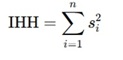
Where:
sᵢ = the market share of each participant (expressed as a percentage or fraction); and
n = the total number of participants.
In football, market share may correspond to the percentage of World Cup titles won by each national team over a given period. The higher the HHI value, the lower the level of competitive balance and the greater the concentration of championships among a small number of teams.
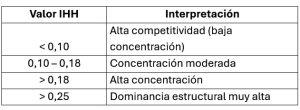
In this context, competitive inequality and title concentration are analyzed using the Herfindahl–Hirschman Index (HHI), based on Hirschman’s conceptualization of concentration as a function of two key variables that characterize market structure: inequality and the number of firms. Inequality has a direct effect on concentration, whereas the number of firms influences it inversely. Consequently, for a given level of inequality, a larger number of football teams results in lower concentration, while, holding the number of teams constant, higher levels of inequality lead to greater concentration. This analytical framework systematically evaluates how structural differences in countries’ economic resources and footballing tradition are reflected in patterns of competitive inequality and title concentration throughout the history of the FIFA World Cup.
Within this framework, we measure the relationship between World Cup champions and participating teams by considering the winning national teams and the number of titles they secured from the inaugural FIFA World Cup, held in Uruguay in 1930, through the 2022 edition in Qatar, encompassing a total of 22 World Cup tournaments contested during that period.
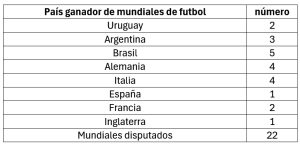
Accordingly, the resulting HHI is 0.1570, placing it within the category of moderate concentration according to the scoring scale presented above.
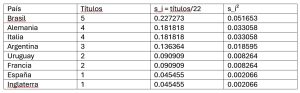
Σsᵢ² = 0.157024
Although 22 editions of the FIFA World Cup have been contested, only eight different national teams have won the title. In other words, just 36.3% of the tournament’s editions have produced different champions. Nevertheless, the distribution of titles among Brazil, Germany, Italy, Argentina, and the remaining champions is relatively more balanced than in many of the world’s leading domestic leagues, where one or two clubs dominate the vast majority of championships, particularly in Europe’s Big Five leagues—Italy, England, France, Spain, and Germany—as we previously demonstrated in the article Football and Hegemony.
This finding indicates that there is no absolute monopoly capable of establishing the complete hegemony of a single national team.
In conclusion, the FIFA World Cup exhibits a higher level of competitive balance than Europe’s major football leagues, such as those of Italy, Spain, England, France, and Germany, where HHI values exceed 0.25 and, in some cases, approach 0.35. Nevertheless, the tournament continues to reveal a clearly defined historical elite of champion nations.
Referencias
Owen PD, Owen CA. Evidencia de simulación sobre las medidas de equilibrio competitivo de Herfindahl-Hirschman en ligas deportivas profesionales. Journal of the Operational Research Society 2022; 73:285–300. https://doi.org/10.1080/01605682.2020.1835449.
Parry SJ. Hegemonía y deporte. J Philos Sport 1983; 10:71–83. https://doi.org/10.1080/00948705.1983.9714402.
Rottenberg S. El mercado laboral del jugador de béisbol. Journal of Political Economy 1956:242–58.

