
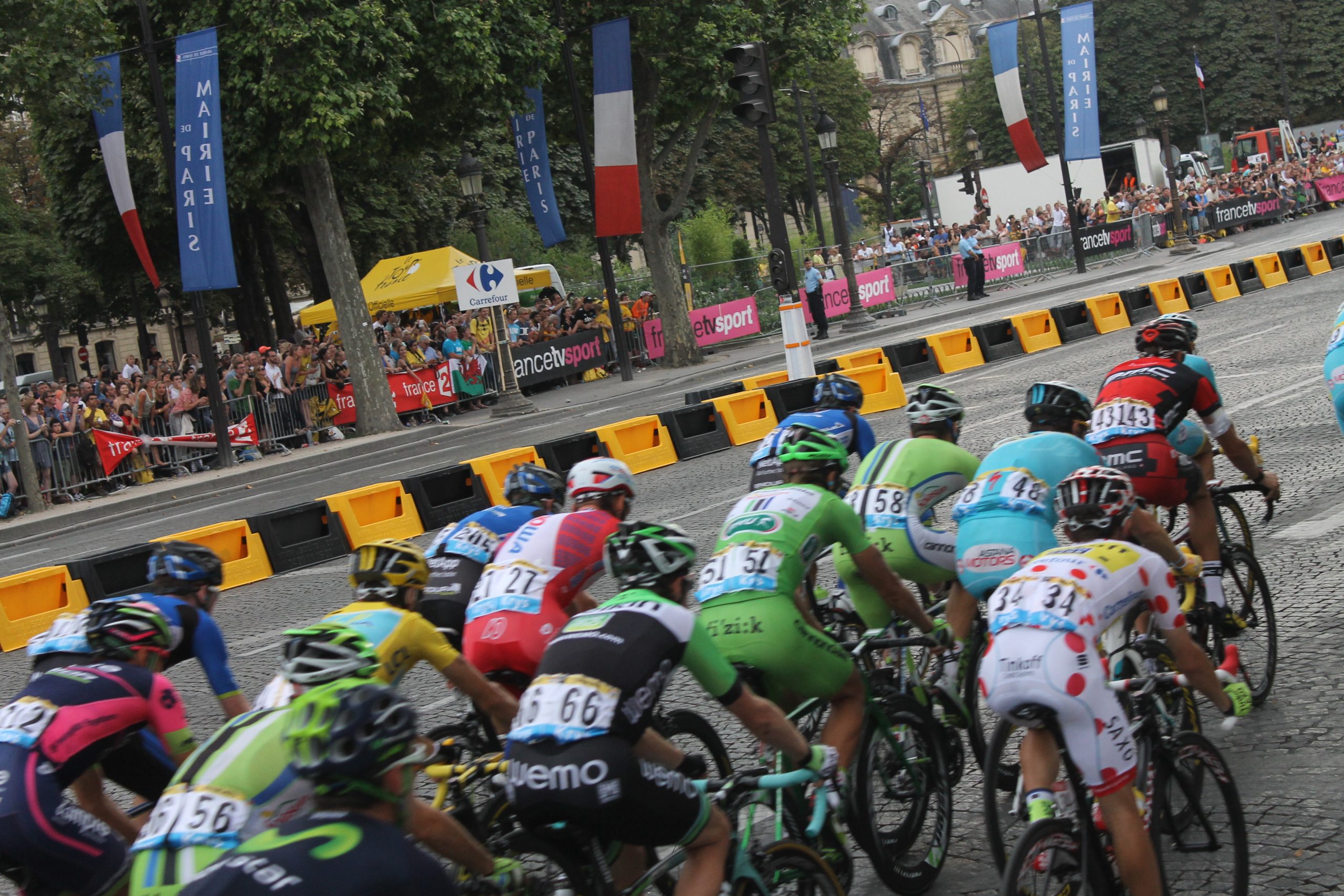
 By
By This Saturday, July 4, marks the start of the 113th edition of the Tour de France, the road race in which 184 cyclists from 23 teams will compete for the podium and for the awards given to the best climber (polka-dot jersey), best young rider (white jersey), best team, and best points classification rider, based on finishing positions and intermediate sprints (green jersey). Although cycling, in all its forms, is not among the world’s most popular sports, the Tour de France is the second-largest sporting event in terms of audience, according to the portal Limelight Digital. The French race is watched by 3.5 billion people, surpassed only by the 5 billion viewers who follow the FIFA World Cup.
By Sandro Angulo Rincón
The Tour de France, the world’s most important three-week cycling race, has been held since 1903 and has been suspended only twice, due to the First and Second World Wars: from 1915 to 1918 and from 1940 to 1946. Although the event took place between 1999 and 2005, the winner of those seven editions, the American cyclist Lance Armstrong, was stripped of his titles for doping.
Identity in cycling is closely linked to road races, since the cyclist is associated with territory, nation, and history. The most important of these races are the Tour de France, the Giro d’Italia, and the Vuelta a España, along with other one-day races — the classics — and one-week competitions, in which cycling remains one of the great celebrated sports in Europe’s Catholic countries, as Gilles Fumey has argued.
According to Philippe Gaboriau and Requião, Moraes, and Silva, the Tour de France has been linked to France’s social and industrial progress, as well as to the contemplation of regions historically associated with the country’s wars. The route is therefore a way of exercising sovereignty over a territory that also stands out for its tourist appeal.
The name La Grande Boucle — “the great loop,” as it is also known in sporting jargon — comes from the fact that its stages have traditionally drawn a large circuit, or loop, around the map of France. However, the race has not been immune to criticism. One critique points to cycling as an Anglophone sport practiced by wealthy white athletes. Indeed, the former Spanish cyclist Fran Ventoso stated that “unfortunately, the peloton in general is classist” on the television program Informe Robinson, while contextualizing how Colombian cyclist Nairo Quintana was discriminated against because of his Indigenous features. With the emergence of Colombian mulatto and mestizo riders in the 1980s, the Tour de France gradually began to move away from its Eurocentric character by allowing the participation of cyclists from diverse ethnic backgrounds.
French cyclists have won the most Tour de France titles, with 38 victories in total, although they have not won the yellow jersey, awarded to the winner of the general classification, since 1985 (see chart).
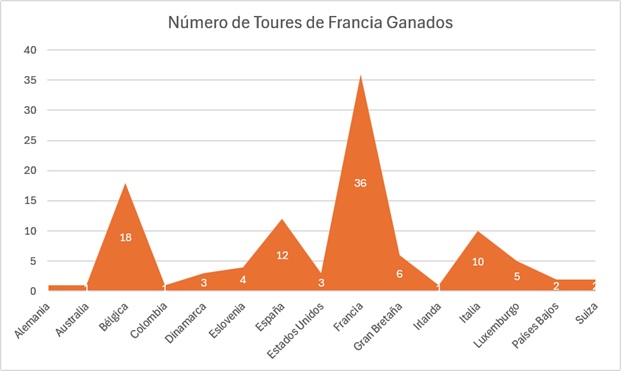
The other most successful nations, in descending order, have been Belgium (18 victories), Spain (12), Italy (10), Luxembourg (6), and Great Britain (5). Colombia (1), the only Latin American country to have won the race, achieved the title with the mestizo rider Egan Bernal in 2019.
In this year’s 113th edition, attention is focused on the battle for the yellow jersey between the Slovenian Tadej Pogačar — already a four-time champion — riding for UAE Team Emirates-XRG and hailing from a nation with limited cycling tradition; the Danish rider Jonas Vingegaard, a two-time winner representing Visma-Lease a Bike; the Belgian Remco Evenepoel of Red Bull-BORA-hansgrohe; and the emergence of two promising talents: the Mexican Isaac del Toro of UAE Team Emirates-XRG and the French cyclist Paul Seixas of Decathlon AG2R La Mondiale Team.
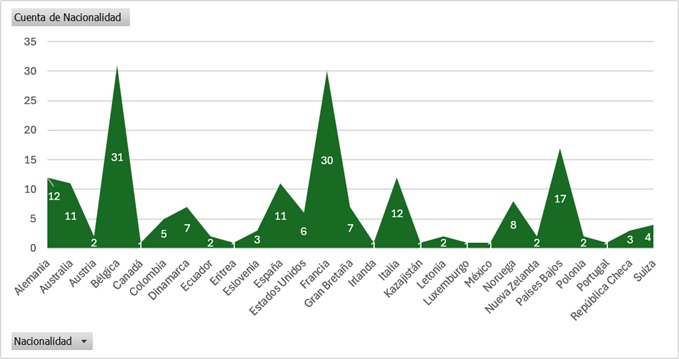
This year, 23 teams and 184 cyclists from 27 countries are competing in the race (see chart). Of these, 155 are Europeans (84.2%), 15 come from the Americas (8.1%), 13 from Oceania (7%), and only one from Africa (0.5%). These figures illustrate the still markedly Eurocentric and elitist character of professional road cycling.
According to the official Tour de France website, of the 21 stages, seven will take place on flat terrain, four in medium mountains, and eight in high mountains, with summit finishes in Gavarnie-Gèdre, Plateau de Solaison, Orcières-Merlette, and Alpe d’Huez (twice). In addition, the race will feature one team time trial and one individual time trial. There will also be two rest days. Out of a total of 37 host locations, the race will visit ten of them for the first time:
- Tarragona, Spain (start of Stage 2);
- Granollers (start of Stage 3);
- Les Angles (finish of Stage 3);
- Gavarnie-Gèdre (finish of Stage 6);
- Hagetmau (start of Stage 7);
- Malemort (start of Stage 9);
- Ussel (finish of Stage 9);
- Circuit de Nevers Magny-Cours (start of Stage 12);
- Plateau de Solaison (finish of Stage 15); and
- Thoiry (start of Stage 21).
The mountain stages will take place, respectively, in the Pyrenees, the Massif Central, the Vosges, the Jura, and the Alps. The Tour will explore several new climbs in the 2026 edition, including the Côte de Begues (Stage 2), the ascent to Gavarnie-Gèdre (Stage 6), the Col de la Griffoul (Stage 10), the Col du Page and the Col du Haag (Stage 14), the Plateau de Solaison (Stage 15), and the Col de Sarenne from its southeastern approach (Stage 20). At 2,642 metres above sea level, the Col du Galibier will be the highest point of the 2026 Tour. The total elevation gain — that is, the sum of all the metres climbed by riders during a stage or throughout the entire race — amounts to 53,950 metres.
Two time trials are scheduled. The opening stage will be a 19-kilometre team time trial in Barcelona, while Stage 16, between Évian-les-Bains and Thonon-les-Bains, will consist of a 26-kilometre individual time trial.
Topics of Debate
There are issues that are only marginally addressed in television broadcasts and social media discussions surrounding the Tour de France, largely due to journalists’ efforts to preserve the race’s reputation and secure sponsorship for future editions. One such issue is undoubtedly climate change, a phenomenon that will affect both the performance and health of cyclists, who will be exposed to extreme temperatures that may exceed 37°C. The situation is considered so serious that the organisers of La Grande Boucle have contemplated moving the event from summer to autumn. Nevertheless, sporting events of this nature, which should serve as platforms for promoting clean energy and bicycle mobility, rarely allow environmental activism during the stages.
Another controversy that has emerged in recent years concerns the increasingly risky attitude adopted by some riders during mountain descents. Descending at speeds of 70 or 80 kilometres per hour merely to gain a few seconds on rivals has transformed cycling into an extreme sport, one in which risking one’s life appears increasingly normalised, evoking comparisons with the Japanese kamikaze pilots of the Second World War.
Three additional issues continue to fuel debate during every edition of a Grand Tour: (1) the economic disparities among teams in their ability to recruit the best riders, physiotherapists, analysts, coaches, and medical and psychological staff, disparities that are often enormous compared with smaller teams and that contribute to an unequal distribution of victories and prize money in favour of wealthier organisations; (2) the need for a three-week Grand Tour to be held in the Americas, a continent with thousands of practitioners and millions of fans, in order to provide cycling with a more genuinely global projection; and (3) the persistent shadow of technological, nutritional, and pharmacological doping, which continues to hang over the sport, particularly at a time when unprecedented athletic performances have intensified suspicions regarding the transparency of competitors in the pursuit of victory.
Nevertheless, the Tour de France remains a competition that guarantees spectacle and excitement. Although cycling itself is an expensive sport to practice, enjoying it from the roadside is not, as spectators can watch their heroes from close range without having to purchase tickets to cheer them on during each stage.
References
Fumey, G. (2006). Le Tour de France ou le vélo géographique. Annales de Géographie, 4(650), 388-408.
Gaboriau, P. (2003). El Tour de Francia y la Belle Epoque del ciclismo. Revista Sociedad y Economía (4), 137-158.
Informe Robinson (2015). Programa de televisión. Canal + España.
Requião, P. y Moraes, M. (2017). O ciclismo de estrada e a construção de uma cultura nacionalista: um olhar sobre o Tour de France. Movimento Revista de Educação Física da UFGRS, 23(1), 407-418.
Foto de portada: Sandro Angulo Rincón.

